Jax Teller's Iconic Quotes & Memorable Moments That Defined Him
From the moment he roared onto our screens, astride his Harley-Davidson, Jax Teller – the charismatic, conflicted antihero of Sons of Anarchy – carved a permanent place in television history. Portrayed with raw intensity by Charlie Hunnam, Jax wasn't just a biker; he was a philosopher in leather, grappling with moral dilemmas and the harsh realities of outlaw life. His journey from a disillusioned club member to the complex, often tragic, President of SAMCRO was punctuated by powerful, introspective lines that offered a window into his soul. These are Jax Teller's Iconic Quotes & Memorable Moments, words that resonate long after the final credits rolled, defining a character forever etched in our collective consciousness.
At a Glance: Unpacking Jax Teller's Legacy
- Complex Antihero: Jax Teller embodies the ultimate antihero, striving for good within a world built on crime, making his internal conflicts incredibly compelling.
- Voice of a Generation: His quotes often reflect universal themes of loyalty, family, power, and the pursuit of redemption, wrapped in the gritty realism of outlaw life.
- Evolution of a Leader: Witness his transformation from a hopeful son seeking reform to a ruthless president making impossible choices, each step marked by profound statements.
- Defining Moments: Certain lines are forever tied to pivotal, heartbreaking, or triumphant scenes, amplifying their emotional weight and impact.
- Enduring Impact: Jax's words continue to spark discussion and analysis, underscoring the show's depth and his unforgettable character arc.
The Man Behind the Words: A Glimpse into Jax Teller's World
Jackson "Jax" Teller's story is one of destiny, loyalty, and the crushing weight of legacy. As the son of John Teller, the deceased founder of the Sons of Anarchy Motorcycle Club, Redwood Original (SAMCRO), Jax inherited not just a patched vest but a profound internal conflict. His father's manuscript, "The Life and Death of SAMCRO: How the Sons of Anarchy Lost Their Way," became his bible, guiding his often-futile attempts to steer the club away from crime and towards a legitimate future. Yet, the deeper he delved, the more he became entangled in the very brutality he sought to escape. His dialogue, sharp and often poetic, perfectly encapsulated this struggle. If you're looking to dive deeper into his entire journey, we've got Everything about Jax Teller in one comprehensive guide.
His quotes aren't just dialogue; they are philosophical musings on the nature of good and evil, family and betrayal, freedom and imprisonment. They highlight a man caught between his ideals and the violent necessities of his world.
Echoes of Loyalty: Brotherhood, Family, and the Bonds That Break
At the heart of Sons of Anarchy lies the concept of brotherhood – a bond thicker than blood, forged in steel and sacrifice. Jax Teller, perhaps more than anyone, embodied this ideal, even as he was forced to betray it to protect what remained. His reflections on loyalty are some of his most potent and often heartbreaking.
"You can't fake brotherhood. Either you got it, or you don't." This quote speaks to the authenticity of the SAMCRO bond, a natural connection that transcends mere membership. Jax believed in this fiercely, seeking out genuine connections over forced allegiances. It's a sentiment that often put him at odds with those he felt had lost their way.
The paramount importance of his inner circle comes through clearly: "Family is the only thing that means a goddamn thing." For Jax, "family" extended beyond blood relatives to the men he rode with, though the lines often blurred painfully. When he said, "We're not just members; we're a family," it underscored his vision for SAMCRO – a unit bound by love and mutual protection, not just criminal enterprise. This ideal was often tested to its breaking point.
The constant push and pull of allegiances created deep wounds. "Every man's gotta choose who he's loyal to." This wasn't a casual observation; it was a lived reality for Jax, forcing impossible decisions that tore him apart. Ultimately, in a world where trust was a luxury, loyalty became currency: "When you're an outlaw, loyalty is all you've got." He understood that in their brutal existence, the unwavering support of your brothers was the only thing that could keep you alive. This understanding culminated in his stark realization: "When you're an outlaw, loyalty is your code, and betrayal is your death sentence." The stakes were always life and death.
A moment forever etched in the hearts of fans came with the simple, gut-wrenching line, "Opie, I got this." Uttered to his best friend, Opie Winston, before a devastating act of revenge, it was a testament to his protective nature and the depth of their bond. This wasn't just a quote; it was a promise, a burden, and a foreshadowing of the profound losses Jax would endure. The very foundation of his life was built on these fragile, often doomed, connections.
The Shadowed Crown: Leadership, Power, and the Weight of the Gavel
Jax Teller's ascension to the presidency of SAMCRO was both his greatest ambition and his ultimate curse. His words on leadership reveal a man grappling with the heavy mantle of power, striving to lead a club he loved into a future he increasingly doubted.
The journey to the top was never easy, and Jax understood the unspoken rules of power: "You can't sit at the head of the table if you don't have a chair." This wasn't just about physical presence; it was about earning respect, commanding authority, and having a legitimate claim to leadership. He knew that the chair had to be earned, often through blood and difficult choices.
Once at the helm, he embraced his role with fierce pride and an unyielding will: "I'm the king of this kingdom, man. The king doesn't run." This wasn't arrogance, but a declaration of responsibility, a refusal to abandon his post even when faced with insurmountable odds. It also spoke to his fatalistic acceptance of his role. When he asserted, "When you run shit, you don't run from shit," it became his personal mantra, demonstrating his resolve to confront every challenge head-on, no matter how dangerous.
The loneliness of leadership frequently surfaced in his words: "It ain't easy being king, but it's harder being you." A poignant reflection on the burdens he carried, contrasting his perceived power with the struggles of others, perhaps even those he led. It showcased his empathy, even as his actions often seemed devoid of it. He understood that power was not inherent but constructed by circumstance: "You know, the funny thing about kings, they're not born, they're made by circumstances." His own path to the presidency was a testament to this, forged by tragic events and the failings of those before him.
Ultimately, Jax’s philosophy on power shifted from its acquisition to its application: "In the end, it's not about the power; it's about how you use it." This statement encapsulated his evolution, recognizing that the true measure of a leader wasn't just the authority they wielded, but the impact they had, for better or worse, on their world.
Moral Compass in a Crooked World: Choices, Consequences, and the Blurry Line
Jax Teller lived in a world of stark choices, where every decision had brutal consequences. His struggle to maintain a semblance of morality within the club's criminal enterprises became the central conflict of his character. His quotes often laid bare his internal turmoil, showcasing a man wrestling with his own nature.
"I'm not a good man, but I'm not an evil one either." This self-assessment perfectly articulated his antihero status. He committed heinous acts, yet often for reasons he believed were just or necessary to protect his family and club. It was a constant tightrope walk.
Life in SAMCRO offered few easy answers, forcing him into impossible positions: "Sometimes, a man's gotta choose." These choices were rarely between clear right and wrong, but rather between two evils. He learned to accept that "Sometimes, you gotta do what you gotta do," even if it meant sacrificing his own soul. This pragmatic, often brutal, outlook was born of survival.
The moral ambiguity of his world led to a profound understanding of human nature: "The truth is, no one's ever 100% good or bad." This nuanced perspective allowed him to navigate a landscape populated by complex characters, many of whom, like himself, were a mixture of light and shadow. The lines he walked were always shifting: "The line between right and wrong is always gonna be a little blurry." It wasn't an excuse, but a statement of fact in his violent reality.
Every action in an outlaw's life carried immense risk: "Every decision you make in this life, it's a 50/50 shot." This fatalistic view highlighted the constant peril and uncertainty that defined his existence. And with every decision, the reckoning was inevitable: "You can't escape the consequences of your actions; they always catch up to you." Jax understood this deeply, as his own past relentlessly pursued him, shaping his present and ultimately his future. His path was paved with noble intentions, yet led to destruction: "The road to hell is paved with good intentions." A grim reminder that even the purest motivations can lead to the darkest outcomes when entwined with a life of violence.
The Outlaw's Creed: Life, Death, and the Embrace of Destiny
Jax Teller's existence was defined by the outlaw lifestyle. His quotes reflect a deep-seated acceptance of his fate, a romanticized yet brutally realistic view of life outside the law, and the ultimate price of that freedom.
He saw the outlaw as a dying breed, a last vestige of American rugged individualism: "Outlaws. One of the last true American frontiers." It was a romantic notion, often contradicted by the grime and brutality of their daily lives, but it underscored the sense of belonging he found in SAMCRO. For Jax, there was no other path: "We're in the outlaw game. No other way to live." This was not a choice but an inescapable reality, a destiny he was born into.
His identity was inextricably linked to the club: "We ain't ever been nothing but who we are." This statement was both a lament and an defiant acceptance. They were Sons of Anarchy, and that defined their essence. His words emphasized their self-made rules: "We're outlaws, brother. We don't follow the law; we make our own." This rebellious spirit was central to the club's ethos, a cornerstone of their independence and defiance.
In their world, death was not an abstract concept but a constant companion: "When you're an outlaw, death is just a part of the job." This chillingly pragmatic view highlighted the ever-present danger and the fatalistic acceptance of their mortality. Yet, Jax yearned for something more, recognizing the grim reality behind the romantic veneer: "This life, it ain't romantic or free. There's no path to anything that makes any sense." It was a powerful admission of disillusionment, an understanding that the freedom they chased often led to a different kind of prison.
In the end, he recognized that authenticity, however flawed, was all that mattered: "In the end, you've got to be what you are." There was no escaping his true nature, the man molded by SAMCRO. This acceptance culminated in his poignant reflection on mortality: "In the end, we're all just chalk lines on the pavement waiting to be washed away." A poetic and grim acknowledgement of the fleeting nature of life, especially one lived on the razor's edge.
Wisdom in the Chaos: Reflections on Humanity and the World
Beyond the immediate concerns of club business, Jax Teller often offered profound, sometimes cynical, observations about the human condition, love, hate, and the bewildering nature of existence. These quotes showcased his evolution into a thoughtful, albeit hardened, individual.
His often-repeated phrase, "Chaos is what killed the dinosaurs, darling," delivered with a wry smile, was a dark reminder that unchecked disorder ultimately leads to destruction. It was a warning he understood but often failed to heed within his own life.
Jax understood the corrosive power of hatred, born from repeated injustices: "It's hard not to hate. People, things, institutions. When they break your spirit and take pleasure in watching you bleed, hate is the only feeling left." This raw admission spoke to the deep wounds inflicted upon him and his loved ones. Yet, paradoxically, he observed: "The more you hate, the more you love." A testament to the idea that intense emotions, even negative ones, are often rooted in deep care and connection.
He also had a knack for simplifying complex problems, though the execution remained elusive: "Every solution to every problem is simple. It's the distance between the two where the mystery lies." A profound insight into the gap between theoretical knowledge and practical application, a struggle he faced daily as he tried to "fix" SAMCRO.
His wisdom extended to the fundamental forces guiding human connection: "Fear and guilt are the sisters of love and loyalty." This quote highlights the complicated interplay of emotions that bind people together, especially in a world where danger and moral compromise are constants. He saw the universal human struggle, even among outlaws: "We're all outlaws. It's just a question of who you want to be an outlaw for." It framed a philosophical choice, suggesting that everyone operates outside some societal norm, making it about allegiance.
Amidst the turmoil, he held onto a simple truth: "Life's too short for regrets." A defiant embrace of his choices, however dark, reflecting a man who lived fully, without looking back. Yet, underneath the bravado, lay immense pain: "The truth is, my heart hurts. And I just don't know how to fix it." This vulnerable admission revealed the toll his life had taken, exposing the deep emotional wounds he carried.
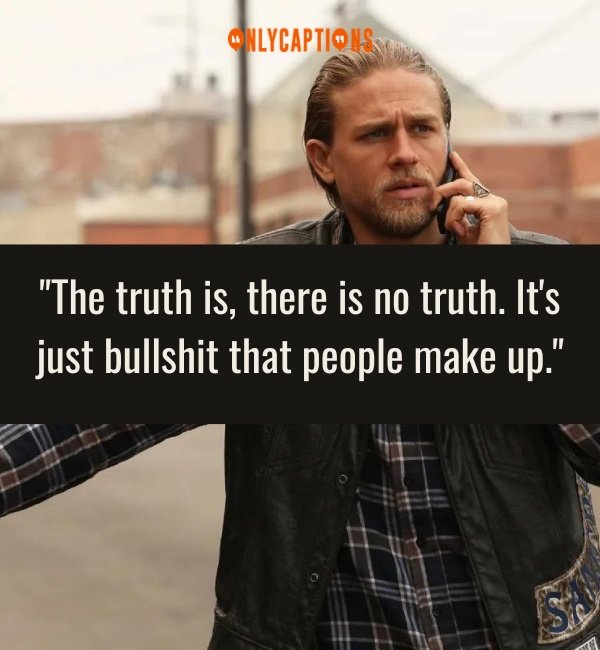
He understood that fear, rather than paralyzing, could be a catalyst: "Fear doesn't shut you down; it wakes you up." It was a survival mechanism, a heightened awareness born of constant peril. In such a world, sanity itself became a challenge: "You have to be a savage to stay sane in a crazy world." This chilling insight explained the brutal pragmatism necessary to navigate the depths of the criminal underworld without losing one's mind entirely. His cynical worldview often led him to question the very nature of reality: "The truth is, there is no truth. It's just bullshit that people make up." A powerful statement on the subjective nature of belief and the narratives people construct to justify their actions.
Memorable Moments: Quotes in Context
Jax Teller's quotes gained their full power when delivered within the show's most pivotal and emotionally charged scenes. These moments weren't just about the words; they were about the weight of his performance, the context of the scene, and the irreversible turning points they represented.
The Weight of Opie's Death: "Opie, I got this."
Few moments hit viewers harder than the sacrifice of Opie Winston. When Jax utters, "Opie, I got this," it's a desperate plea, a futile attempt to protect his best friend from a horrific fate. This scene perfectly encapsulates the crushing cost of the outlaw life, driving Jax deeper into his vengeful, violent path. The quote isn't just about a promise; it's about the unbearable burden of leadership and the profound guilt of being unable to save those you love.
Confronting the Past, Forging the Future: Jax's Journal Entries
Throughout the series, Jax's internal monologue, often delivered as voiceovers of his journal entries, provided the philosophical backbone of his journey. Phrases like "In this life or the next, it's gonna find you" often opened episodes, setting a somber, fatalistic tone. These moments, where his inner thoughts were laid bare, gave profound insight into his motivations, his hopes for the club, and his growing despair. His struggle to reconcile his father's vision with the grim reality of SAMCRO was a constant narrative thread, framed by these introspective monologues.
The Final Ride: A Grim Acceptance of Fate
Jax's ultimate journey towards self-sacrifice, accepting the consequences of his choices, was a series of memorable moments culminating in his iconic final ride. There's no single final quote, but his actions, his knowing glances, and the quiet dignity of his final moments speak volumes. He embraced his destiny, completing a cycle that began with his father. His quiet farewells and the poignant imagery of his last ride solidified his legacy, making his actions the ultimate quote on his terms of life and death. The final moments where he becomes "chalk lines on the pavement" underscore the fatalism he spoke of.
Jax Teller's Enduring Legacy: Why His Words Still Resonate
Why do Jax Teller's quotes continue to captivate audiences and ignite discussions years after Sons of Anarchy concluded? It's because they transcend the gritty specifics of outlaw biker life to touch upon universal human experiences.
He was a character defined by his contradictions: a loving father who committed horrific acts, a seeker of peace who propagated violence, a man yearning for freedom who was trapped by loyalty. His words, therefore, speak to the complexity of the human spirit. They explore themes that resonate deeply:
- The Weight of Legacy: How do we honor our past while forging our own future?
- The Price of Loyalty: What sacrifices are we willing to make for those we love?
- The Corruption of Power: How does authority change us, for better or worse?
- The Search for Redemption: Can a person truly escape their past, or find forgiveness for unforgivable acts?
- The Nature of Good and Evil: Is true morality possible in a compromised world?
Jax Teller's raw honesty about his own flaws – "I'm not a good man, but I'm not an evil one either" – made him relatable, even amidst his brutality. He was a tragic hero, a man who tried to break the cycle but ultimately became a victim of it, his words charting every step of that inevitable descent. His philosophical musings offer a lens through which we can examine our own choices, our own loyalties, and the compromises we make in our lives.
Living with the Echoes: What Jax Teller Taught Us
Jax Teller's journey, punctuated by his searingly honest and often painful declarations, reminds us that life is a series of choices, each with a ripple effect. He taught us that true leadership comes with immense responsibility, that loyalty is a double-edged sword, and that the path to redemption is often paved with unforeseen costs.
His story is a powerful narrative on the human condition – the constant struggle between our ideals and the harsh realities we face. While his world was one of violence and crime, the core dilemmas he grappled with are universal. They challenge us to reflect on our own definitions of family, honor, and justice. Jax Teller might have been an outlaw, but his words offer a profound, if dark, wisdom that compels us to look inward and consider the legacies we are building, and the choices that define us.